
Developing a reliable atomic layer deposition (ALD) process involves much more than finding conditions that produce a film. The reactants must be selected carefully, the self-limiting nature of the surface reactions must be demonstrated, and the composition, material properties, uniformity, nucleation and conformality of the film must be assessed. Eventually, the process should also be safe, reproducible, scalable and compatible with its intended application.
To help researchers navigate these interconnected aspects of ALD process development, we are publishing an extensively updated version of our 10-step workflow for ALD process development. The complete guide can be downloaded from the new AtomicLimits ResourceHub (add link). This new section of AtomicLimits will complement the ALD and ALE databases, ImageBase and ReviewBase by bringing together practical guides and other resources for the atomic-scale processing community.
The original workflow was published on AtomicLimits in 2019 by Martijn Vos, Adrie Mackus and Erwin Kessels. It was intended as a practical starting point for researchers new to ALD process development and as a concise checklist for more experienced users. With more than 5,000 downloads, the guide has found its way into research laboratories, courses and presentations around the world. We are very happy to see it being used as a reference by both newcomers to ALD (such as myself a few years ago) and experienced researchers within the community.
Over the past seven years, feedback from the community and our own experience have encouraged us to revisit the workflow. The basic ten-step structure has proven useful, but several steps have been reordered or more clearly defined and the guidance throughout the document has been expanded. The updated version also places greater emphasis on experimental uncertainty, comprehensive reporting and the documentation of the experimental context. These aspects are important for making results easier to interpret and reproduce, especially for generating the structured, high-quality data required for future AI-assisted research.
The updated workflow focuses primarily on the development of ALD processes for binary materials. Most of its principles also apply to multicomponent and doped films, but these introduce additional questions concerning precursor combinations, cycle ratios, supercycles and composition control. Developing a systematic workflow for these more complex processes therefore deserves a separate discussion. Perhaps for a future addition to the ResourceHub 😉!
The updated 10-step workflow
The ten steps are arranged in a broadly chronological order, but they should not be regarded as a rigid recipe. The most appropriate sequence depends on the material, process, reactor, available characterization methods and intended application. Iteration is also an essential part of process development: results obtained in a later step may show that an earlier step needs to be revisited.
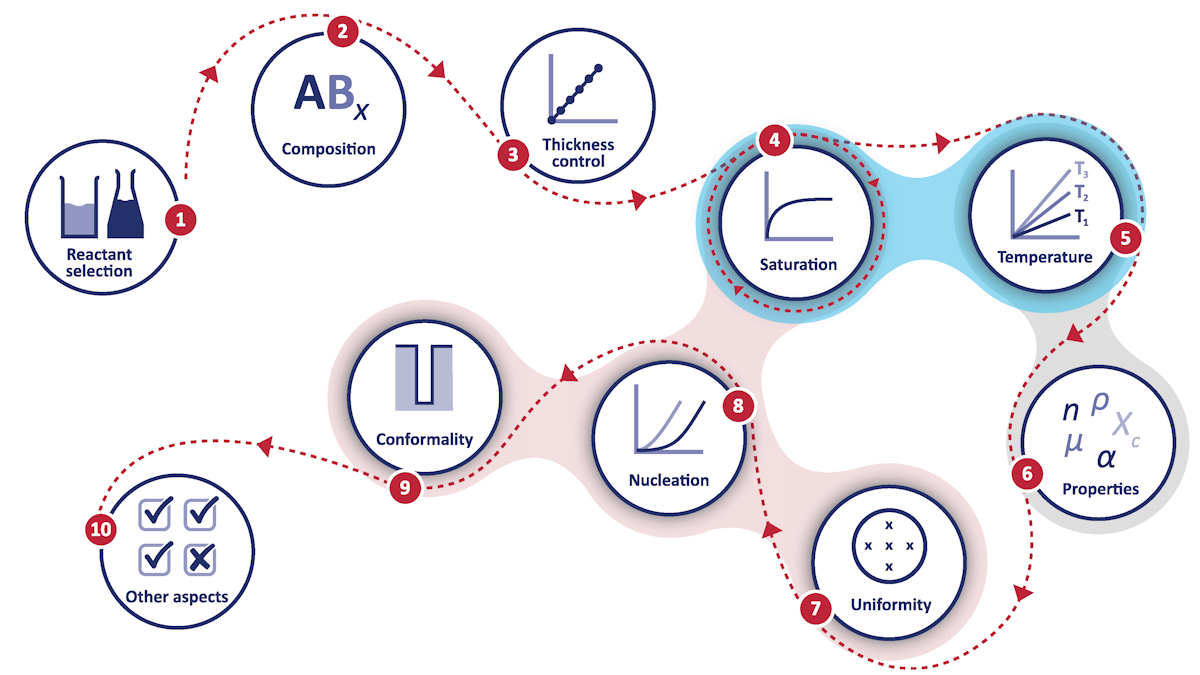
The updated workflow is summarized in the figure below. The colored circles highlight several important interdependencies. In particular, saturation behavior should be reconsidered when changing the deposition temperature or when unexpected results are obtained for uniformity, nucleation or conformality. Film composition and properties can also depend strongly on temperature.
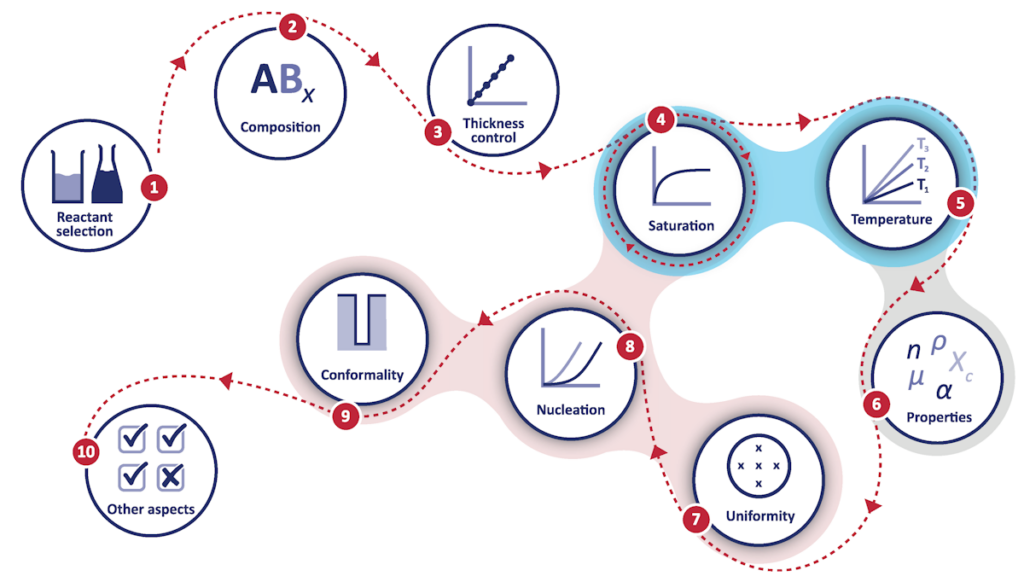
In brief, the ten steps address the following questions:
- Reactant selection: Which precursor and co-reactant will be used?
- Initial composition check: Did the first experiments produce approximately the intended film composition?
- Thickness control: Does the deposited amount of material increase linearly with the number of cycles?
- Saturation: Are the surface reactions during precursor dosing and co-reactant exposure self-limiting, and are the purge times sufficient?
- Temperature dependence: Over which substrate-temperature range is self-limiting ALD behavior obtained?
- Detailed composition and material properties: What are the detailed film composition and material properties, and do they meet the requirements?
- Uniformity: Are the film thickness and relevant properties uniform across the substrate?
- Nucleation behavior: How does growth during the initial cycles differ from the steady-growth regime?
- Conformality: How uniformly are the film thickness and relevant properties distributed throughout three-dimensional structures?
- Practical implementation and validation: Is the process safe, stable, reproducible, scalable and compatible with its intended use?
Each of these steps is discussed in detail in the downloadable guide. Here, we focus on the most important changes compared with the original 2019 workflow and on how the workflow should be used in practice.
What changed in version 2.0?
At first glance, the updated workflow may look familiar (and intentionally so). Our aim was not to change the original workflow, but rather to refine and strengthen it based on the experience gained since its publication. The central aspects of ALD process development remain unchanged, while their purpose, order and interdependencies have been defined more clearly.
In the updated workflow, a clearer distinction between an initial screening and a detailed characterization of the composition has been made. It now separates the rapid composition check in Step 2 from the comprehensive characterization in Step 6. Step 2 is intended to answer an early and practical question: have the first experiments produced approximately the intended material? A quick XPS measurement or a suitable proxy, such as electrical conductivity or refractive index, may be sufficient at this stage. If the result differs fundamentally from the target, it is better to reconsider the reactants or initial process conditions before investing substantial time in optimization. Detailed analysis of the film properties follows later, once the basic growth conditions have been established.
Besides that, the order of Steps 5 and 6 is swapped: temperature dependence now precedes the detailed composition and material properties. In the original workflow, material properties were considered before the temperature dependence. We have reversed this order because composition, structure and functional properties typically depend strongly on the deposition temperature. It therefore makes sense to first determine over which relevant temperature range self-limiting growth is obtained and then select the most appropriate conditions for detailed characterization.
Additionally, the nucleation behavior now precedes conformality. Nucleation determines how growth begins on the intended starting surface and can influence film closure, crystallinity, resistivity and the properties of ultrathin films. It is therefore useful to understand the initial growth regime before moving to the more application-specific assessment of conformality in three-dimensional structures.
The ordering of uniformity, nucleation and conformality (Steps 7, 8 and 9) remains deliberately flexible. Researchers working on area-selective deposition may wish to examine nucleation at an earlier stage, whereas conformality may deserve higher priority when developing a process for demanding three-dimensional structures. Not every laboratory will have access to suitable high-aspect-ratio test structures or sensitive in situ measurements. In such cases, the depth and method of characterization can be adapted using suitable ex situ approaches or external facilities.
The final step has also been expanded from “other aspects” to “practical implementation and validation.” A process is not fully developed simply because favorable results have been obtained once on a small sample. The updated Step 10 therefore addresses safety, film and interface stability, run-to-run repeatability, reactor history, precursor delivery, process transfer, throughput, scalability, process integration and application-level validation. These considerations connect process development more directly to reliable research and eventual practical implementation.
Finally, the updated guide places a much greater emphasis on documenting the complete experimental and analytical context. A new appendix summarizes the information that should be recorded for each process-development experiment. This addition is closely connected to one of the broader motivations for the update: making ALD data more complete, reusable and suitable for future AI-assisted research.
Using the workflow
The workflow is intended to be used systematically without being treated as rigid. Completing a step does not necessarily mean that it can be left behind permanently. A change in temperature, substrate, reactor configuration or intended application may require earlier experiments to be repeated.
A well-developed ALD process should be supported by a coherent set of evidence. The intended material should be formed, the deposited amount should be predictable and the surface reactions should be self-limiting under the relevant conditions. The composition and properties of the film should be understood, while uniformity, nucleation and conformality should be assessed to a level appropriate for the intended application. Finally, the process should be reproducible and suitable for practical use.
The recipe alone, however, captures only part of the information needed to understand or reproduce an ALD process. Reactor design and history, precursor delivery, substrate preparation, the actual substrate temperature and the methods used to characterize the film can all influence the result. These details should therefore be recorded together with the measured data and the decisions made during process development.
From complete experiments to reusable data
The updated guide includes a new appendix summarizing the experimental and analytical context that should be documented. This includes the objective of the experiment, reactor and run identity, substrate and reactant information, the complete recipe, measurement methods, uncertainties and data-processing choices. Unsuccessful, negative and unexpected results are also valuable and should be retained, together with the reasoning behind the next experimental step.
Following a shared workflow does not by itself guarantee that results obtained in different laboratories can be compared directly. Nevertheless, using consistent terminology and documenting the relevant experimental context are important first steps toward more complete and reusable ALD datasets. Reporting templates, community-agreed terminology and structured database formats can build on this foundation. Such developments will also be essential for the future use of artificial intelligence in ALD research. AI can help identify patterns, retrieve knowledge and suggest promising experiments, but only when the underlying data is sufficiently reliable, structured and well documented.
For me, working on this update also reinforced that ALD process development is not simply about optimizing a recipe. It is about building a convincing set of experiments and recording the experimental context and reasoning that led to the final process.
We hope that the updated workflow will provide a useful starting point for researchers entering the field and a practical reference for more experienced ALD users. The complete guide can be accessed through the new AtomicLimits ResourceHub. As with the original workflow, we very much welcome feedback from the community and suggestions for future improvements!


