
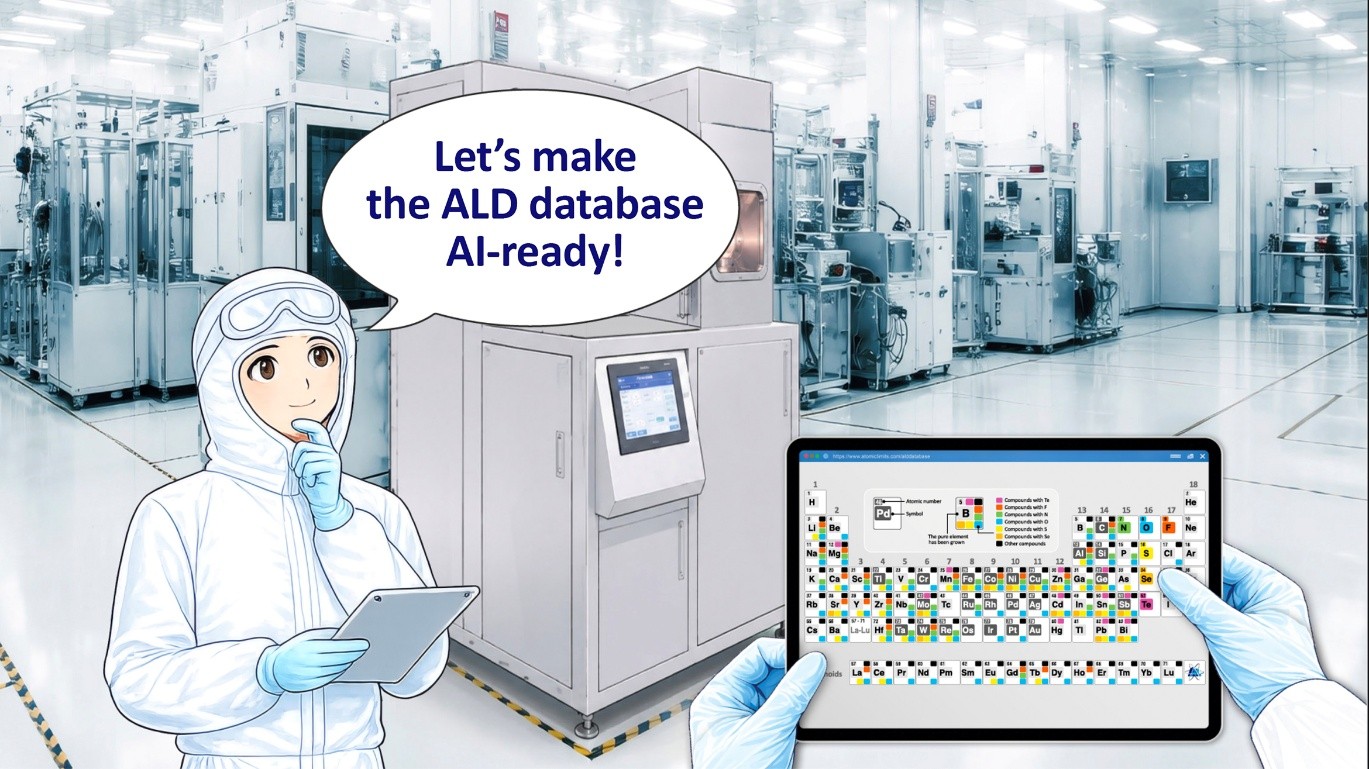
Our Perspective paper, “The AtomicLimits Database: Towards Artificial Intelligence as a Research Assistant for Atomic Layer Deposition and Etching”, has just been published in Chemistry of Materials, and we are delighted to share it with you. To mark the occasion, we would like to share the vision behind it: how can the AtomicLimits ALD/ALE database evolve from a familiar periodic table into a foundation for an AI research assistant?
Since 2019, the AtomicLimits ALD database has offered an open, community-supported overview of ALD processes reported in the literature. It was later joined by the ALE database, extending this resource to atomic layer etching. By clicking on an element in the periodic table, you can see which materials containing it have been deposited or etched, which reactants were used, and in which publications the processes were reported. Today, the ALD database covers more than 2400 processes for over 660 materials, and the ALE database lists close to 300 processes for 71 materials.
Over the years, many of you in the atomic-scale processing community have told us that the database has become a go-to resource in your work. We hear this from researchers in academia and industry alike. For many users, it is the first stop when developing a new process: checking which precursor and co-reactant combinations have been reported for a material before stepping into the lab. It is also a natural starting point for newcomers to ALD, giving students and researchers entering the field a quick overview of what has been done and where to find the original papers. Beyond that, it supports computational screening and serves as a data source for review papers.
At the same time, ALD itself has evolved. ALD processes can also involve much more than a simple AB cycle. Additional precursor doses, plasma treatments or inhibitor exposures can enable multicomponent films or selective deposition. Capturing these processes requires more detail than a list of materials and reactants alone.
In 2023, as we were beginning to explore ChatGPT and discover what AI could mean for our own research, we had the opportunity to take the database a step further through AWASES (“AI-Aware Pathways to Sustainable Semiconductor Process and Manufacturing Technologies”), an open-IP program funded by Merck and Intel. It brings together TU/e, the University of Warwick, and the TIB – Leibniz Information Centre for Science and Technology and L3S Research Center in Hannover. The goal was not only to expand the database with more data but, more importantly, to make it ready for AI. To be honest, we did not know exactly where it would take us.
Since then, the potential of AI as a research assistant has become much clearer. It is increasingly used as a research partner, from searching the literature to suggesting new experiments. ALD and ALE are no exception: machine learning models now predict film properties, generative AI helps discover new precursors, and agentic AI systems have begun planning and running processes directly on a reactor. These applications depend on reliable, well-structured data, both to train models and to provide the information that AI assistants retrieve and use. Through AWASES, we have started to see how AI could accelerate ALD/ALE process design, and how much depends on structured, well-documented experimental and computational data.
The possibilities turned out to extend well beyond what we initially imagined. To illustrate the direction we are working towards, we created a mockup of a future AI-ready AtomicLimits database. Please enjoy the video below.
Mockup of a future AI-ready AtomicLimits ALD database. Alongside the familiar periodic table, the proposed interface includes natural-language search and a built-in AI assistant, AtomGPT, for retrieving process data and publications.
The video starts with a familiar situation: you want to deposit a material by ALD, let’s say ZnO, so you check the AtomicLimits database. But what if this resource could offer more? The mockup imagines an interface where you can ask an AI assistant questions, upload your own data, and explore a dashboard bringing together the available ZnO data. It then looks further ahead: asking the assistant to design a recipe for your reactor, having that recipe run on the tool, and eventually asking which film to design next.
The mockup illustrates our vision for how an AI-ready AtomicLimits database could support ALD and ALE research. Making this vision a reality starts with the data: what information would such an assistant need, and how should we collect, describe and share it? These questions are at the heart of our Perspective.
The answer is not simply more data. We need high-quality experimental and computational data, reported with enough detail to make studies comparable and reproducible. In practice, this means structured formats, consistent terminology and units, and complete metadata. Take something as simple as a precursor name. Diethylzinc appears in papers as DEZ, DEZn, diethyl zinc or Zn(C2H5)2. A human reader familiar with ALD recognizes these as the same molecule; a database needs to link them consistently to the same chemical identity. Reactor configurations, characterization methods and process conditions also need to be recorded explicitly, yet essential details are often missing from publications.
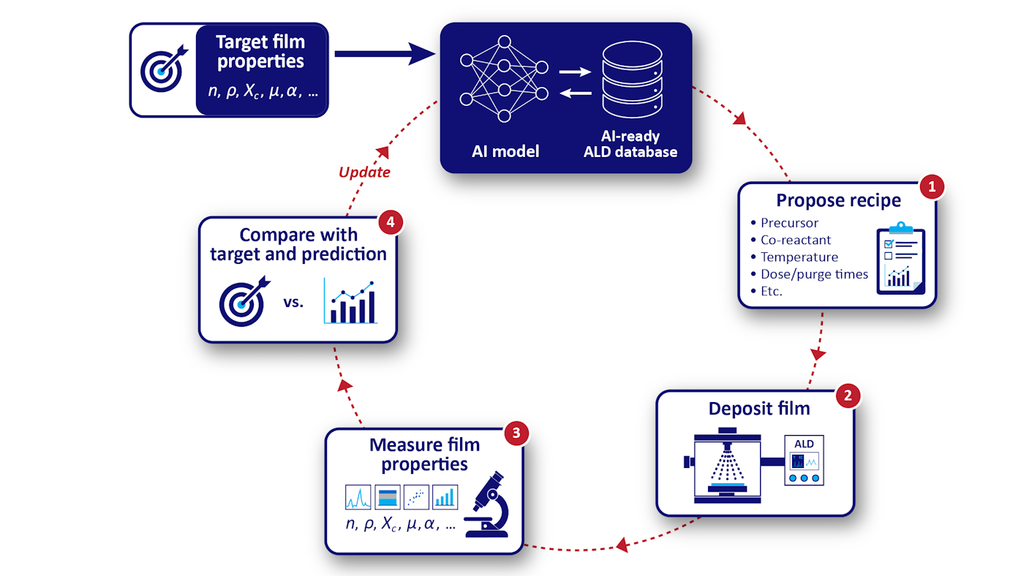
In the Perspective, we propose a framework that connects data extracted from the literature with experimental and simulation data, organized using a shared, community-defined schema. This would allow AtomicLimits to grow into an AI-ready knowledge infrastructure, supporting applications ranging from comparing processes across studies to designing new recipes and, eventually, running experiments autonomously. We believe self-driving ALD labs will be an important next step for the field, and this framework could help lay the groundwork.
Building the foundation for all of this will require contributions from across the atomic-scale processing community. In the Perspective, we suggest practical steps that different groups can take:
- Researchers can report experimental details more fully and share raw data, unsuccessful experiments and results that fall outside the intended process window.
- Lab managers and principal investigators can establish group-level reporting templates and explore electronic lab notebooks.
- Journals and conferences can introduce requirements for structured supporting information and raw data sharing.
- Tool manufacturers can provide machine-readable reactor outputs and support recipe import and export in open formats.
- Software developers can build on existing ontologies and platforms such as ORKG and NOMAD.
- As a community, we can establish a working group to develop a shared ALD/ALE reporting template.
Our Perspective is a starting point for a community discussion. We would love to hear what you think of the mockup, which data you would want an AI-ready database to contain, and whether you would like to help develop a shared reporting template.
The familiar periodic table has helped researchers find ALD and ALE processes for years. With richer data and a shared effort, it could also become the foundation for an AI research assistant that helps us decide what to try next.
E. Poupaki, A. Watkins, S. Sadruddin, R. Jordan, V. K. Narasimhan, S. Auer, J. D’Souza, B. Karasulu, A. J. M. Mackus and W. M. M. Kessels, “The AtomicLimits Database: Towards Artificial Intelligence as a Research Assistant for Atomic Layer Deposition and Etching”, Chem. Mater. (2026)
For a complementary view focused on machine learning methods, see J. Westermayr, S. F. Bent and R. Tonner-Zech,“Opportunities and Challenges of Machine Learning in Atomic Layer Deposition”, Chem. Mater. 38, 2142–2155 (2026).


