
As you might have noticed, we have just started a year in which we celebrate the discovery of the Periodic System by Dmitri Mendeleev: 2019 is the 150th anniversary of the Periodic Table of Chemical Elements and has therefore been proclaimed the “International Year of the Periodic Table of Chemical Elements (IYPT2019)” by the United Nations General Assembly and UNESCO.
Of course, within the field of atomic layer deposition (ALD) we also cherish the Periodic Table a lot. As a matter of fact, it is often used to show which materials have been prepared by ALD. As far as I know, Riikka Puurunen started with this in her highly-cited review paper that appeared in Journal of Applied Physics [1] in 2005. This review paper gives a very helpful overview of all ALD processes that were reported in the literature up to February 2005. Several years later, this table was updated by Ville Miikkulainen, Markku Leskelä, Mikko Ritala, and Riikka Puurunen in another ALD review paper that was published in Journal of Applied Physics [2]. This review, which appeared in 2013 contained an overview of all materials prepared by ALD reported in the literature up to December 2010. Although extremely valuable for all of us that are interested in ALD, both papers only contained a black-and-white version of the figure which is not well suited for fancy presentations about ALD. Furthermore, having arrived in 2019, it is very urgent to have an update to the Periodic Table with ALD-prepared materials available.
For this reason, I have arranged an updated, colorful version of the Period Table with ALD materials, see below. The starting point was the aforementioned paper by Ville Miikkulainen, Markku Leskelä, Mikko Ritala, and Riikka Puurunen and the update was done with help of Harm Knoops.
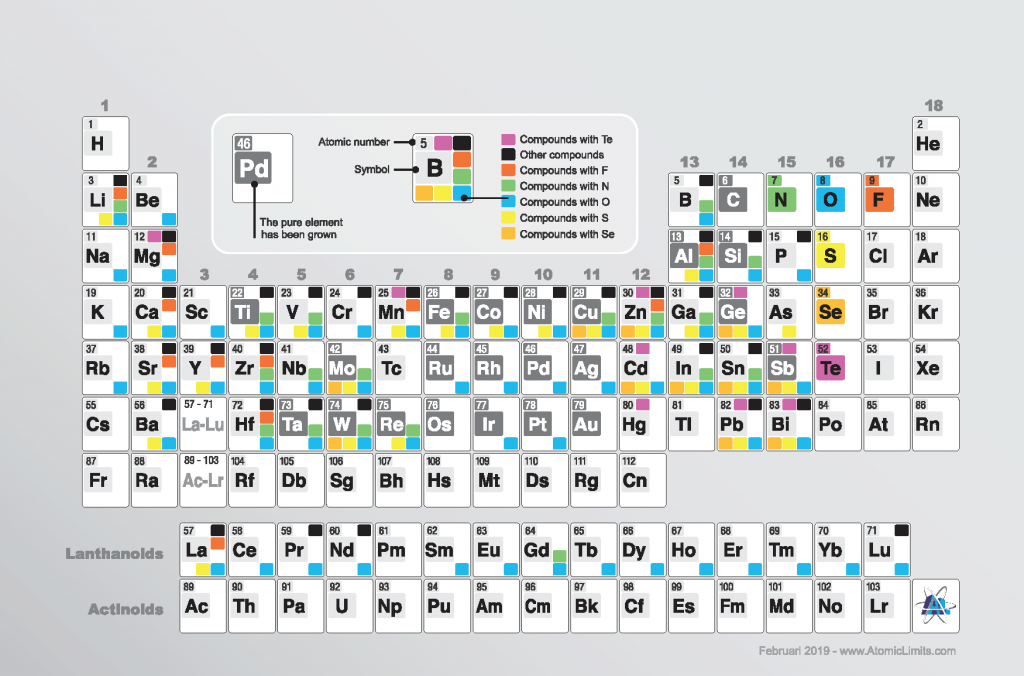
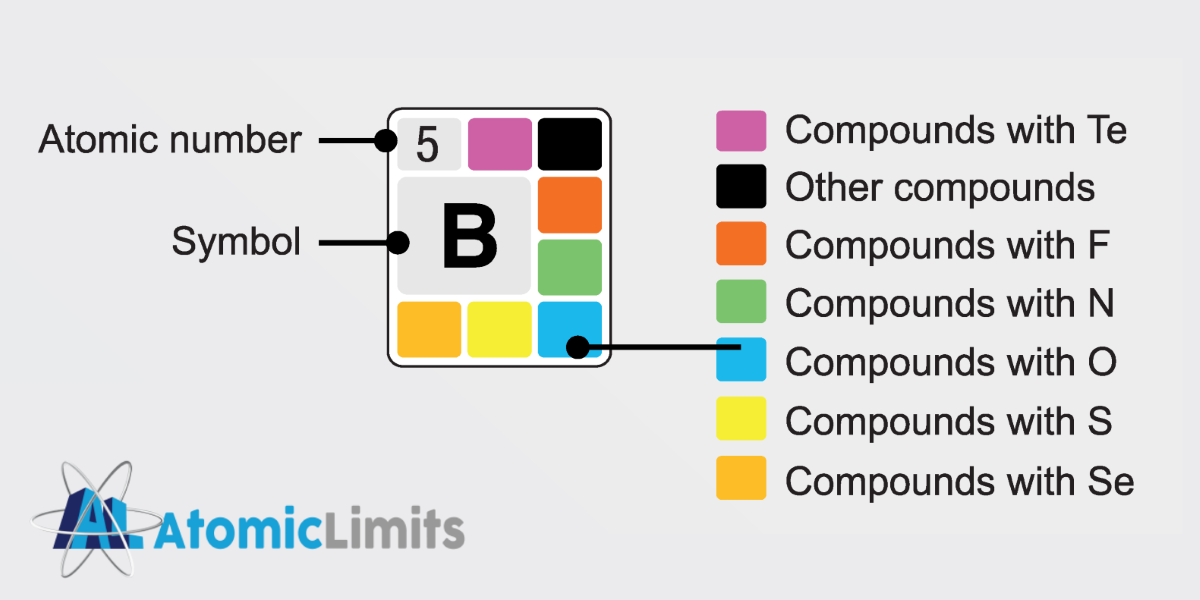
Overview of the materials prepared by ALD. Growth of pure elements as well as compounds with oxygen, nitrogen, sulphur, selenium, tellurium, fluorine, and other compounds grouped together is indicated through shadings of different types at different positions. The elements are named according to the recommendations of The International Union of Pure and Applied Chemistry (IUPAC). – Update February 2019. 
This work is licensed under a Creative Commons Attribution 4.0 International License.
In case a new material has been added to class of materials prepared by ALD, please leave a comment on this blog (see below). The same thing can be done if you find an error or have any other comment/correction to make. The intention is to update the figure every year.
Download table figure – update February 2019
High resolution files of the Periodic Table with ALD materials can be downloaded here
This work is licensed under a Creative Commons Attribution 4.0 International License.
References
Publications containing a Periodic Table to present an overview of the materials prepared by ALD:
[1] Surface chemistry of atomic layer deposition: A case study for the trimethylaluminum/water process, R.L. Puurunen, J. Appl. Phys. 97, 121301 (2005). (http://dx.doi.org/10.1063/1.1940727)
[2] Crystallinity of inorganic films grown by atomic layer deposition: Overview and general trends, V. Miikkulainen, M. Leskelä, M. Ritala, and R.L. Puurunen, J. Appl. Phys. 113, 021301 (2013). (http://dx.doi.org/10.1063/1.4757907)
[3] Metal ALD and pulsed CVD: Fundamental reactions and links with solution chemistry, D.J.H. Emslie, P. Chadha, J.S. Price, Coordination Reviews, Coordination Chemistry Reviews 257, 3282 (2013). (http://dx.doi.org/10.1016/j.ccr.2013.07.010)
[4] Atomic layer deposition, H.C.M. Knoops, S.E. Potts, A.A. Bol, and W.M.M. Kessels, Chapter 27 in “Handbook of Crystal Growth” (T. Kuech eds.), Elsevier (2015). (https://www.elsevier.com/books/handbook-of-crystal-growth/kuech/978-0-444-63304-0)
(download a free copy of the chapter here).

Hi!
Really appreciate this table! I noticed that you are missing Li3N, which can be found here: https://pubs.rsc.org/en/content/articlelanding/2012/ra/c2ra20731a#!divAbstract
Cheers,
Miia M
Hello!
Thanks for the great work, its indeed a beautiful table! 🙂
A paper just went out describing a first ALD process for the preparation of FexN films, maybe to be added as well?
https://pubs.rsc.org/en/content/articlehtml/2019/cc/c8cc10175b
Best regards,
Thanks Erwin Kessels for continuing this work that I started with the JAP 2005 review http://dx.doi.org/10.1063/1.1940727 (which also started the ALD history work and collected the then-all results on the TMA-water process together).
Making the decision of which processes to report separately and which as “other compounds” was not a self-evident one — and it was also criticised then to me of not being good, actually. Nothing better was proposed in place by the one who criticised it, and I thought – this is maybe not perfect, but it is much better than what has existed before, and worth publishing. It is interesting to see that my way of dividing the materials has now been accepted as a standard way of representing the materials made by ALD.
FYI: your table is missing SnSe. That one we missed, too, in the update of the table in JAP 2013 review https://doi.org/10.1063/1.4757907. More on that the “event” and the reference through here: https://twitter.com/rlpuu/status/1061880880157917184.
Difference between this and my tables has been that mine has come along with a review of the articles reporting on that material. You don’t have such reference list publicly available, do you? It would be worth making – best in an international collaboration? First, though, we need to finish the ALD history project http://vph-ald.com – more volunteers still welcome to join in this open science effort.
Greetings, Riikka Puurunen
Hi, and thanks for the great work!
As2S3 appears to be missing as well, you can find it here: https://doi.org/10.1116/1.4968202
Cheers,
Mikko Heikkilä @HelsinkiALD
Hello!
Superb work, this table is such an important and beautiful presentation what the whole ALD community has been able to achieve so far. Thank you!
Palladium oxide seems to be missing. Link: https://doi.org/10.1016/j.tsf.2013.01.091
Best regards,
Jani Hämäläinen
Hi
Great work – this is very important indeed.
Here are some missing materials me and my colleagues at Helsinki remembered (in no particular order, just one article each):
PbI2 (Pb other compounds):
https://pubs.acs.org/doi/10.1021/acs.chemmater.8b04969
CuCl (Cu other compounds):
https://doi.org/10.1063/1.3525929
Ag2O
https://doi.org/10.3390/coatings8070237
MoOx
many, the first one https://doi.org/10.1039/C0JM01099E
Bi2S3
https://doi.org/10.1021/acs.jpcc.6b12629
SnNx
https://doi.org/10.1021/acs.chemmater.7b04666
Sb2Te3
https://doi.org/10.1021/ja8090388
Sb2Se3
https://doi.org/10.3390/electronics6020027
PbTe and PbTe
https://doi.org/10.1149/2.014406jss
NiCx (Ni other compounds)
https://doi.org/10.1021/acsami.8b00388
PdO
https://doi.org/10.1016/j.tsf.2013.01.091
GeSe
https://doi.org/10.1088/1361-6528/aacda0
MoSe2
https://doi.org/10.1002/pssr.201800023
WSe2
https://doi.org/10.1088/0268-1242/31/9/095002
VSx (,mostly as part of InxVySz)
https://doi.org/10.1021/acs.chemmater.5b04402
Also, not sure how to categorize these: Ni3Sn2 and Co3Sn intermetallic films
https://doi.org/10.1002/admi.201801291
Regards
Miika Mattinen
Some blogtalk here, on how I originally created the “periodic table of ALD processes” and how it was once updated: “On how I came up with the “periodic table of ALD processes” http://aldhistory.blogspot.com/2019/02/atomic-limits-and-how-i-came-up-with.html.
I noted in Twitter (https://twitter.com/rlpuu/status/1092323079898972160) and I note here: I have never claimed that this table would overview “all materials prepared by Atomic Layer Deposition”. It does not. Some scientific humbleness here, please. This periodic table is based on a review of two-reactant ALD processes. Ternary, quaternary, etc. processes are missing, as are all the MLD-ALD processes.
Greetings, Riikka, February 4, 2019
Those who left a comment or update: thank you so much! I very much appreciate it.
I have updated the table and the current version should be pretty accurate as of February.
Hello!
Here is the study on cobalt nitride “Plasma enhanced atomic layer deposition of cobalt nitride with cobalt amidinate”
https://avs.scitation.org/doi/10.1116/1.5062842?af=R
With best wishes,
Remarkable, wonderful worl!!! For even more detail and realistc information, you can include a real image (for example 1nm -IBM) of atoms from the my selection below:
https://www.pinterest.co.uk/jorgyia/real-pictures-of-atoms-nano-stm-afm-scanning-tunne/
Once again accept congratulations.