
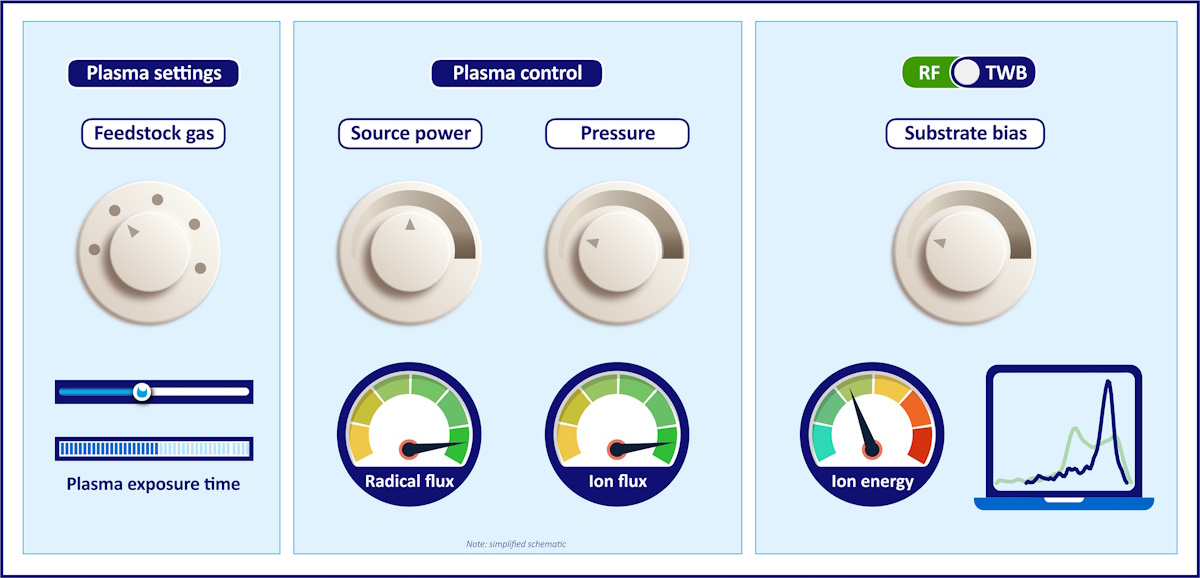
The continued evolution of semiconductor technology—as well as advances in emerging material platforms—places increasingly stringent demands on nanofabrication steps such as etching and deposition. Processes must not only enable atomic-scale thickness control, but also precise control over how surfaces are modified at the nanoscale. In this context, ion energy is becoming an increasingly important process parameter for plasma-enhanced etching and deposition.
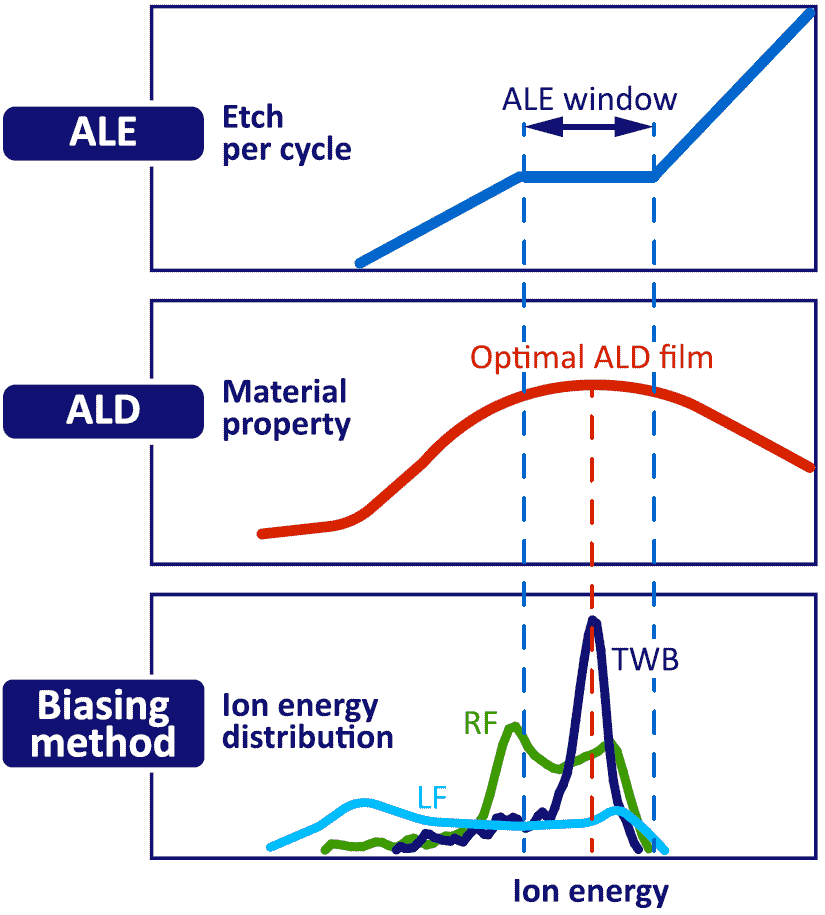
In anisotropic atomic layer etching (ALE), this requirement is particularly clear. The ion energy must fall within a relatively narrow window: high enough to remove a chemically modified surface layer, but low enough to avoid damaging the underlying material. Differences of only a few tens of eV can determine whether the process remains self-limiting or turns into continuous etching.
Perhaps even more important is that a narrow ion energy distribution is essential for selectivity. In many cases, the energy thresholds for removing different materials are separated by only a limited margin. If the ion energy distribution is broad, part of the ion flux will inevitably exceed the threshold of the material that should be preserved, leading to a loss of selectivity. Conversely, simply lowering the average ion energy to avoid this is not an effective solution, as a significant fraction of ions will then fall below the activation threshold for the target material, reducing the etch efficiency. A narrow distribution, therefore, enables the ion energy to be precisely positioned within a window where one material is removed while another remains unaffected, maintaining both selectivity and process efficiency.
In plasma-enhanced ALD (PEALD), the role of ions has also been demonstrated many times, as discussed in a previous blogpost. Ion energy influences film properties such as density, composition, and crystallinity. Here, too, there is typically an optimal energy range—outside of which material quality deteriorates. While this effect is often more subtle than in ALE, precise ion energy control can be equally critical, for example when specific processes are activated above a certain threshold. In such cases, controlling the ion energy distribution determines whether these effects are switched on in a controlled manner—or occur only partially and non-uniformly.
Despite this, the way ion energy is controlled in most plasma processes is fundamentally limited. Conventional LF or RF sinusoidal biasing leads to broad ion energy distributions, meaning that a significant fraction of ions either does not contribute effectively—or causes unwanted damage. As a result, there is a growing need for approaches that allow precise and tunable control over the ion energy distribution.
Several years ago, we revisited tailored waveform (TW) biasing as a strategy to narrow ion energy distributions. This effort built on earlier work within our group, which in turn was inspired by the seminal study by Wang and Wendt published in 2000. We described our earlier work in a publication and blogpost (see references therein). Since then, we have studied various aspects of this approach. In our recent paper, we take a closer look by systematically unraveling how the different parts of the waveform shape the ion energy distribution, and how they can be used as practical control knobs.
As mentioned, when ion energy is controlled using a sinusoidal LF or RF bias, the level of control is inherently limited. In practice, one can mainly adjust the bias amplitude and frequency, and both influence the ion energy in an indirect way. As a result, the ion energy distribution typically remains broad.
Tailored waveform biasing takes a different approach. Instead of a sinusoidal voltage, the substrate is driven with a waveform that can be shaped more freely. This effectively introduces additional parameters—or, in other words, more “knobs”—to precisely control the ion energy distribution. In particular, it becomes possible to adjust the ion energy (via the voltage amplitude) while independently controlling the width of the distribution by compensating surface charging effects.
This decoupling is important. In conventional biasing, increasing the ion energy often comes at the expense of a broader distribution. With tailored waveforms, the ion energy can be tuned while maintaining a narrow distribution—provided that the waveform is designed appropriately.
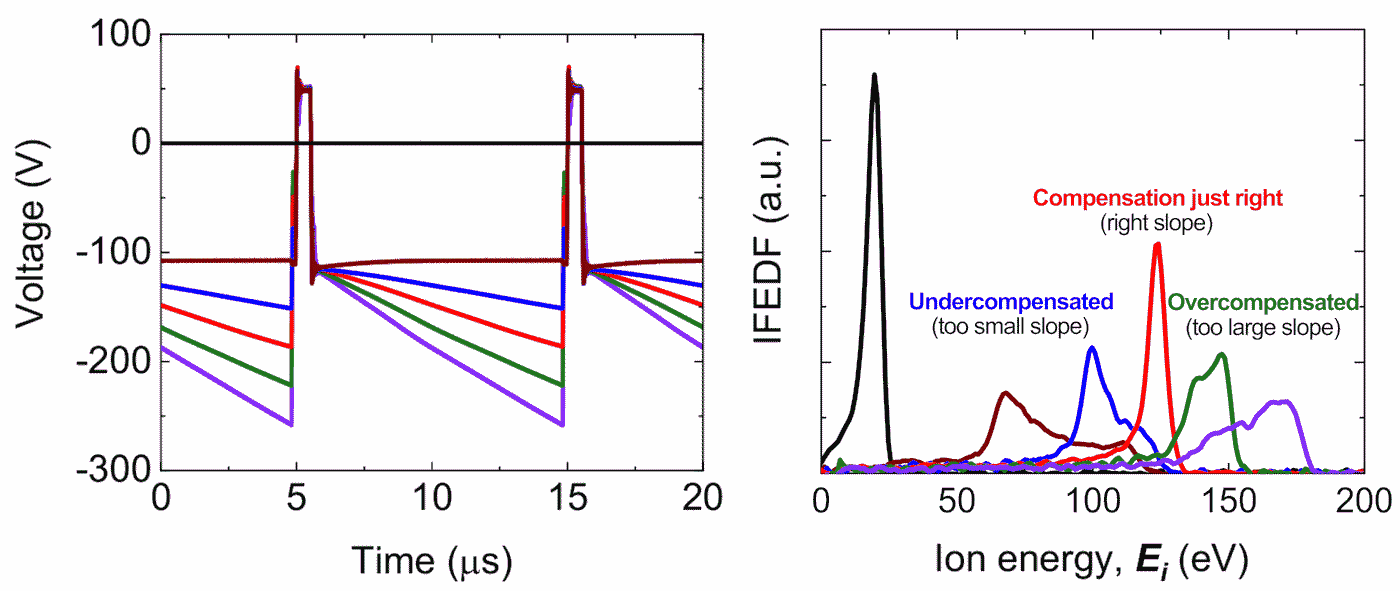
Another practical aspect is that tailored waveform biasing can operate at relatively low frequencies. This avoids some of the complications associated with high-frequency biasing, such as unwanted electron heating and related plasma effects, while still enabling precise control over the ion energy.
Rather than going into the detailed physics here (please refer to the publication), we focus on what this means in practice: tailored waveform biasing provides a richer and more flexible set of control parameters for shaping ion energy distributions in etching and deposition than conventional approaches.
Building on the concepts discussed above, we also demonstrate that tailored waveform biasing can be applied to reactive molecular plasmas such as O₂, N₂, and H₂. This is particularly relevant because molecular gases are widely used in plasma etching, while O₂, N₂, and H₂ plasmas are commonly employed in plasma-enhanced ALD. Molecular plasmas are inherently more complex due to the presence of multiple ion species. Despite this complexity, we show that narrow ion energy distributions and well-controlled ion energies can still be achieved, making the approach directly applicable to a wide range of realistic processing conditions.
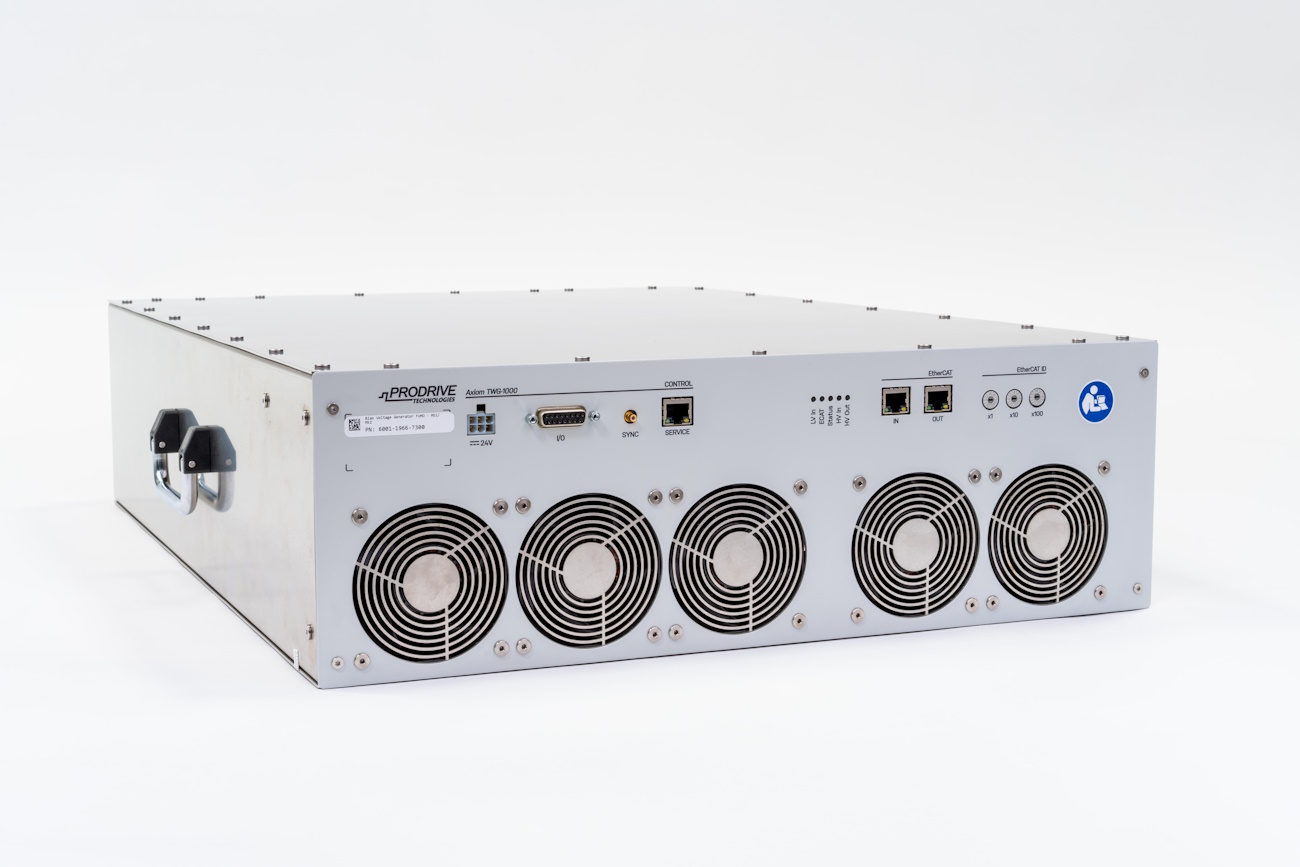
A key aspect to highlight is that all results presented in the new publication —as well as in our earlier paper —were obtained using an industrial tailored waveform generator developed by Prodrive Technologies. Over the past years, this system has undergone significant development and maturation. It now provides stable and flexible control over waveform parameters and is being tested and applied in industrial environments. This is a key point: it shows that the level of ion energy control discussed here is not just an academic demonstration, but is increasingly becoming accessible in practical processing settings.
To summarize, the ability to precisely control ion energy distributions has direct implications for atomic-scale processing. For ALE, it enables better use of narrow energy windows and improved selectivity between materials. For PEALD, it allows more controlled activation of ion-driven processes and more precise tuning of material properties. More broadly, it reinforces the idea that ion energy can be treated as a true process lever, rather than a fixed consequence of the plasma conditions.
In ongoing work, we are extending these concepts toward process demonstrations, including applications in plasma-enhanced ALD. At the same time, we look forward to further results from industrial partners working with Prodrive’s tailored waveform technology, particularly in demonstrating improved processes and device performance. We therefore look forward to further demonstrations of improved processes and device performance—so please stay tuned.
Full references to our publications:
Faraz, T.; Verstappen, Y.; Verheijen, M. A.; Escandon Lopez, J.; Heijdra, E.; van Gennip, W.; Kessels, W. M. M.; Mackus, A. J. M. Precise Ion Energy Control with Tailored Waveform Biasing for Atomic Layer Etching. J. Appl. Phys. 2020, 128, 213301.
Faraz, T.; de Jong, A.A.; Verstappen, Y.; Escandon Lopez, J.; Heijdra, E.; van Gennip, W.; Kessels, W. M. M.; Mackus, A. J. M. Tailored Waveform Biasing in Atomic and Molecular Plasmas for Atomic Scale Processing. J. Vac. Sc. Techn. A 2026, 44, 033004.
