
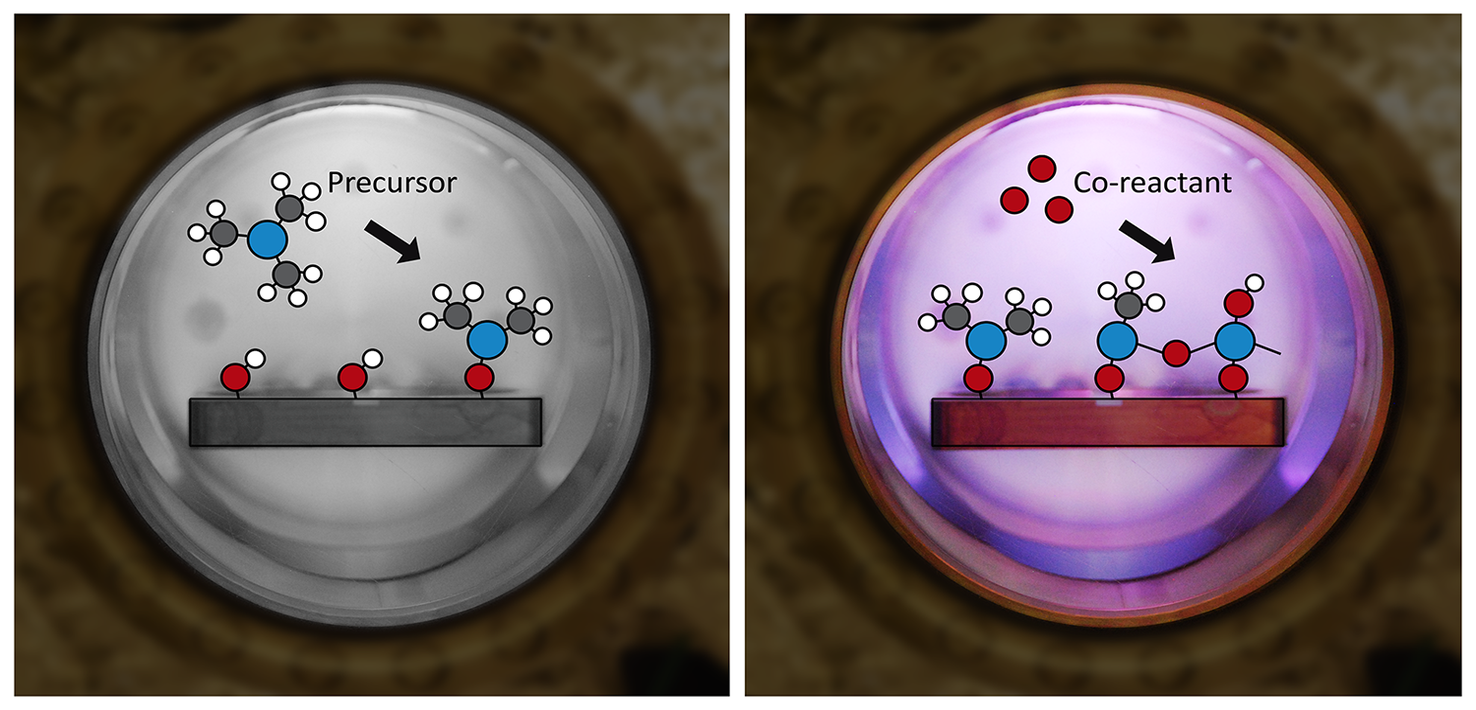
On February 15, 2023 (1:00 pm – 5:00 pm (EDT) I will give an AVS Webinar about the topic plasma-assisted ALD. I gave a similar webinar two years ago and you can read about it here as it was covered by the BALD Engineering blog site. Last year I gave an AVS webinar about “ALD from an Application Perspective”.
This year’s webinar will touch on similar topics as the one two years ago but it will be fully up to date and it will also involve new topics and new schematics and other images. It will draw on two review papers that we published over the years but also on recent work and publications and I will address aspects about I often receive questions. This also includes very technical aspects related to equipment and markets.
The two review papers are:
- Status and prospects of plasma-assisted atomic layer deposition, H.C.M. Knoops, T. Faraz, K. Arts, and W.M.M. Kessels, J. Vac. Sci. Technol. A 37, 030902 (2019)
- Plasma-assisted atomic layer deposition: basics, opportunities, and challenges, H.B. Profijt, S.E. Potts, M.C.M. van de Sanden, and W.M.M. Kessels, J. Vac. Sci. Technol. A 29, 050801 (2011)
A more detailed description of the webinar can be found below, as well as its objectives, and a link to a registration page. I hope to see many of you online on February 15!
Webinar description
Atomic Layer Deposition (ALD) has become a key technology in both the lab and the fab with many devices and other applications benefiting from the (ultra)thin films that can be prepared with very precise thickness control and with unparalleled conformality and uniformity. Nowadays, a significant number of the ALD processes employed are so-called plasma-assisted or plasma-enhanced ALD processes. In the last decade, this method has faced a breakthrough in high-volume manufacturing and an extensive set of processes and reactor designs have been demonstrated. Yet the reasons why and when to use plasma-assisted ALD are often not clear as well what kind of plasma configurations to use and which conditions to apply. Also, misconceptions about the implications of using plasmas during ALD exist, for example with respect to plasma damage and limitations of conformality. This webinar will address these aspects starting with the basics of ALD and plasma-based processing and will range up to the applications that can benefit from plasma-assisted ALD.
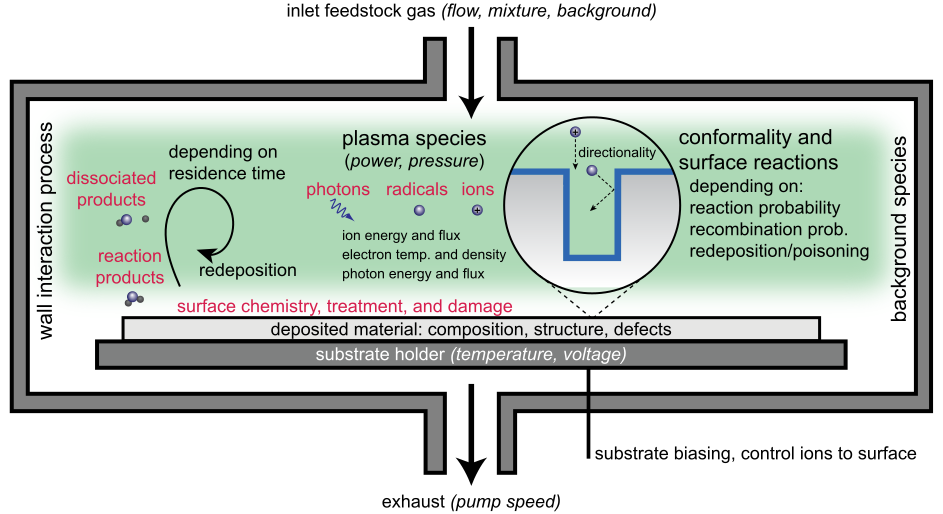
Webinar objectives
- Provide the basic concepts of plasma-based processing and thin film preparation by (plasma-assisted) ALD
- Gain knowledge on the role of reactive and energetic species such as radicals, ions, and photons on the process and resulting film properties, including film conformality on 3D surface topologies
- Present an overview of plasma ALD reactors and discuss important design and processes parameters
- Discuss several plasma-assisted ALD processes for key material systems
- Give insight into existing and potential future applications of plasma-assisted ALD
- Understand the pros and cons of plasma-assisted ALD with respect to thermal ALD
You can register here
